
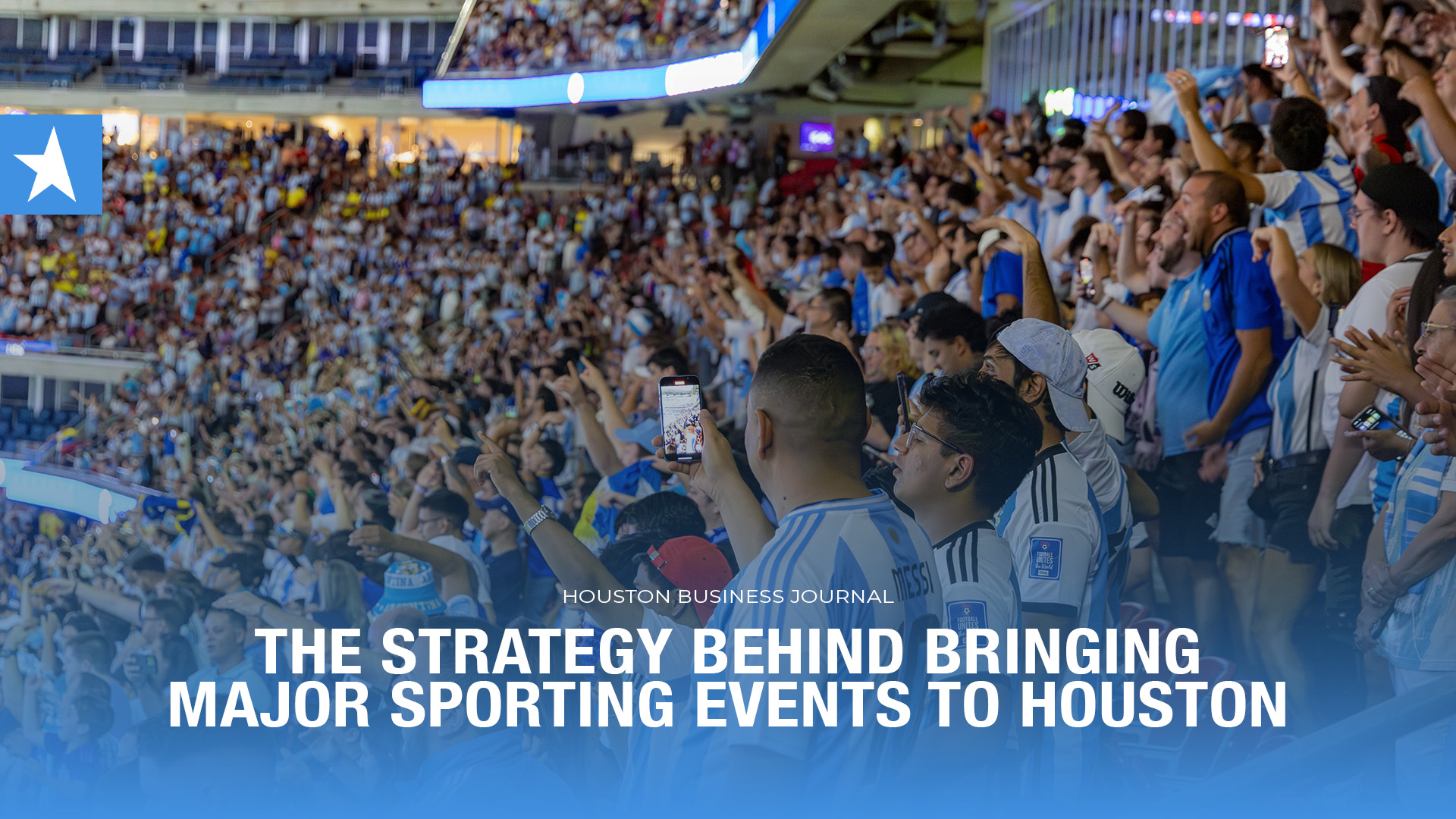
How Houston Secured Three Global Sporting Events for 2026 and What It Means for Houston’s Economy
In 2026, Houston will do something most cities dream of doing and few ever achieve.
In a single calendar year, our region will host the World Baseball Classic, NCAA Men’s Basketball South Regional (Sweet 16 & Elite 8), and FIFA World Cup 26™. Each event on its own is a major undertaking. Together, they represent a rare convergence of global sports, international attention, and record-breaking economic impact.
Behind the bid is an intensive, competitive, and often unseen process led by the Harris County–Houston Sports Authority (HCHSA) in collaboration with our key community partners, venues, and teams across the region. This is the story of how Houston competes for the world’s biggest sporting events and keeps winning.
Winning Starts Long Before the Bid
Every major sporting event begins with a rights holder, whether MLB, the NCAA, or FIFA, issuing a Request for Proposal (RFP) that outlines the scope of the event, including venue requirements, projected attendance, operational needs, fan experience, regional support, and overall vision for the competition.
The RFPs are rigorous, technical, and unforgiving. Cities are scored across dozens of criteria, including facility quality, stakeholder alignment, fiscal responsibility, community enthusiasm, and the ability to deliver at scale under global scrutiny.
HCHSA doesn’t wait for the opportunities to land, rather it continually monitors the global events landscape through industry intelligence, long-standing relationships fostered through the years, and direct engagement with rights holders. The goal is to be ready before the opportunity hits the street.
Turning Opportunity into Reality
Once an RFP is issued, the real work begins. HCHSA convenes a citywide effort bringing together venue operators, sports teams, hospitality partners, transportation agencies, public safety leaders, city and county officials, and community stakeholders. The first question isn’t whether Houston can host the event, but whether it can be executed at an elite level.
Bid submissions are comprehensive and data-driven, detailing venue availability and readiness, hotel inventory and visitor services, transportation and safety logistics, workforce and volunteer support, financials and economic return.
Depending on the scope of the event, the host selection process can take months or even years. The FIFA World Cup 26™ host selection process spanned multiple years, beginning in 2017 with the United Bid (USA, Canada, and Mexico) competing against Morocco, before narrowing 26 finalist cities down to just 16 official host cities. Houston didn’t just make the cut; it has been considered one of the leading host locations based on strong local support, exemplary stakeholder collaboration, and an experienced local organizing committee.
The FIFA World Cup™ is not an exception to this process. That same rigor applied to the World Baseball Classic at Daikin Park —an effort led by the Houston Astros that brought the tournament to Houston for the first time—as well as the NCAA Men’s Basketball Regional, which brought one of college sports’ most storied tournament rounds to Toyota Center for the first time after previously being hosted at NRG Stadium.
Looking beyond 2026, Houston has been awarded several future events, including the 2027 AAU Junior Olympic Games and the 2028 UCI BMX World Championships, a qualifier for the 2028 Olympic Games. Additional bidding efforts are already underway for major international events such as the 2031 Rugby World Cup and the FIFA Women’s World Cup 2031™. This ongoing process ensures Houston remains well positioned as a premier host destination for years to come.
Why Houston Wins
Houston’s success is earned time after time. While many markets also have venues that meet similar requirements, Houston’s advantage lies in coordination, depth, and experience. The region operates as a unified team with city and county leadership, venues, transportation systems, and private partners aligned.
HCHSA’s bids emphasize the region’s unique strengths, from its multicultural population and culinary scene to its world-class venues and extensive air operations through two major international airports. Just as important, Houston’s bids demonstrate unified leadership alignment across city, county and private-sector partners, a shared commitment to execution, and a proven track record of hosting Super Bowls, NCAA Final Fours, World Championships, and international tournaments.
Another key tool in Houston’s competitive advantage is the Texas Event Trust Fund (ETF), administered by Governor Greg Abbott’s Economic Development and Tourism Office, designed to help Texas communities attract large-scale events that generate new economic activity. The ETF strengthens bids by supporting events that draw visitors from outside the region. The program reimburses a portion of incremental state and local tax revenue, such as hotel occupancy and sales tax, generated during an event, based on growth above an established baseline. These funds are derived from new visitor spending, not existing tax dollars, allowing Houston to pursue sporting events responsibly.
Economic Impact That Reaches the Entire Region
Hosting global sporting events generates significant economic value beyond game day. Each major event secured by HCHSA drives hotel occupancy across Harris County, boosts restaurant and retail activity, and supports workforce opportunities across hospitality, transportation, event operations, and small businesses. The benefits ripple far beyond downtown, reaching neighborhoods, suburban communities, and regional partners—strengthening the local economy, supporting jobs, and highlighting why investing in major events delivers meaningful returns across the region.
The convergence of the World Baseball Classic, the NCAA Men’s Basketball Regional, and FIFA World Cup 26™ in the same year reflects more than a full events calendar; it reflects a long-term strategy focused on sustained regional impact. Collectively, these events represent one of the most significant economic cycles Houston has ever experienced.
Projected Economic Impact:
- FIFA World Cup 26™: $1.5 Billion
- World Baseball Classic: $112 Million
- NCAA Men’s Basketball Regional: $10.5 Million
Execution Is the Final Test, and Houston Delivers
Winning the bid is only the beginning. The true measure comes in bringing the event to life, and Houston delivers through close collaboration with venue operators, public safety agencies, transportation partners, and the FIFA World Cup 26™ Houston Host Committee, which operates under HCHSA’s umbrella to coordinate planning and operations.
Houston’s ability to consistently attract and execute major sporting events is built on partnership, preparation, and performance. By aligning regional assets, leveraging strategic incentives, and working hand-in-hand with stakeholders across the city and region, Houston doesn’t just host events—it creates unforgettable experiences, showcases our region on the world stage, and proves time and time again that we can deliver at the highest level.
